
Mortgage rates remain one of the biggest financial concerns for Americans considering buying or refinancing a home in 2026. With borrowing costs still significantly higher than the ultra-low rates seen earlier in the decade, even a small change in mortgage rates can have a meaningful impact on monthly payments.
As of August 17, 2026, the average 30-year fixed mortgage rate is around 6.69%, keeping affordability at the center of the housing conversation.
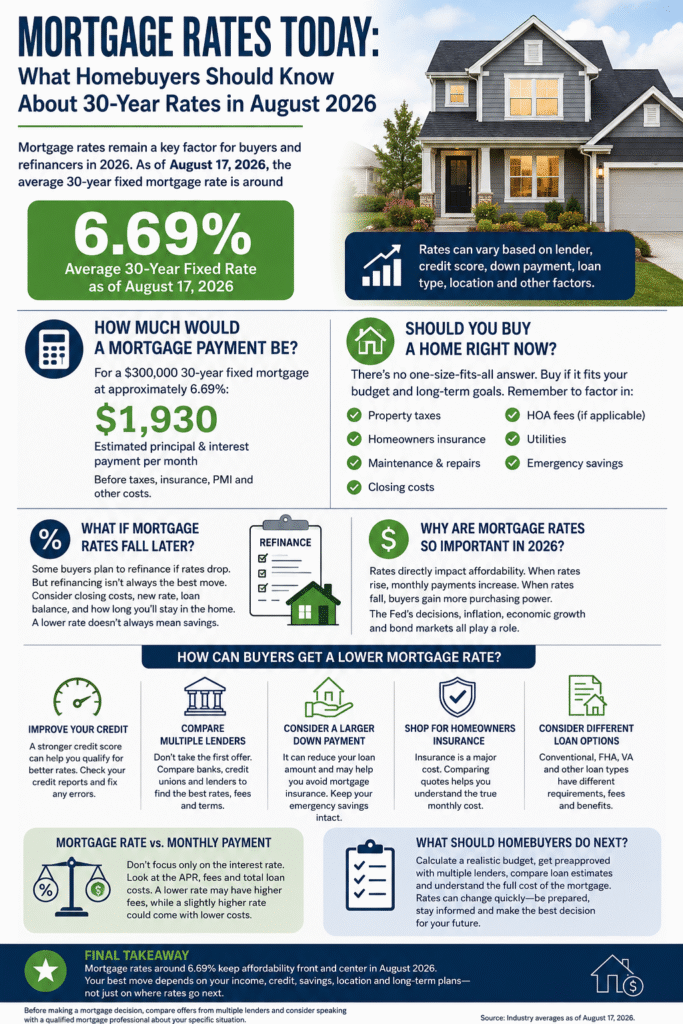
What Is the Mortgage Rate Today?
The average 30-year fixed mortgage rate is currently around 6.69%. Rates can vary depending on the lender, borrower credit score, down payment, loan type, property location and other financial factors.
For homebuyers, the difference between 6.69% and a rate that is only a few tenths of a percentage point lower can translate into thousands of dollars in interest over the life of a mortgage.
How Much Would a Mortgage Payment Be?
Consider a $300,000 30-year fixed mortgage at approximately 6.69%.
The principal-and-interest payment would be roughly $1,930 per month, before property taxes, homeowners insurance, mortgage insurance and other costs.
A buyer with a larger down payment or stronger credit profile could potentially qualify for better terms.
That’s why comparing multiple mortgage offers can be one of the most important steps before purchasing a home.
Should You Buy a Home Right Now?
There is no single answer that works for every buyer.
For people who have stable income, enough savings for a down payment and can comfortably afford the monthly payment, buying may still make sense.
However, buyers should avoid stretching their budgets simply because they expect mortgage rates to fall later.
A home purchase involves more than the mortgage payment. Buyers should also account for:
- Property taxes
- Homeowners insurance
- Maintenance and repairs
- Closing costs
- HOA fees, when applicable
- Utilities
- Emergency savings
What If Mortgage Rates Fall Later?
Some buyers are choosing to purchase when they find the right property and consider refinancing later if rates decline.
However, refinancing is not guaranteed to be beneficial. Homeowners normally need to consider closing costs, the new interest rate, their remaining loan balance and how long they plan to stay in the property.
A lower rate doesn’t automatically mean refinancing will save money.
Why Are Mortgage Rates So Important in 2026?
Mortgage rates have a direct effect on housing affordability.
When rates rise, monthly payments generally increase, reducing the amount many buyers can comfortably borrow. When rates decline, buyers may gain additional purchasing power.
The Federal Reserve’s interest-rate decisions, inflation, economic growth and bond-market movements can all influence mortgage rates.
That’s why homebuyers are closely watching economic data and upcoming Federal Reserve decisions.
How Can Buyers Get a Lower Mortgage Rate?
There are several steps borrowers can take to potentially improve their mortgage offer.
Improve Your Credit
A stronger credit profile can help borrowers qualify for more competitive mortgage terms. Before applying, check your credit reports and address inaccurate information.
Compare Multiple Lenders
Don’t automatically accept the first mortgage offer.
Comparing banks, credit unions and mortgage lenders can help you identify differences in rates, fees and loan terms.
Consider a Larger Down Payment
A larger down payment can reduce the amount borrowed and may also affect mortgage insurance requirements.
However, buyers shouldn’t drain their emergency savings just to increase their down payment.
Shop for Homeowners Insurance
Homeowners insurance is another major cost of owning a property. Comparing insurance quotes can help buyers understand the true monthly cost of homeownership.
Consider Different Loan Options
Depending on your circumstances, you may have several financing options available, including conventional, FHA and VA loans.
Each option has different eligibility requirements, fees and benefits.
Mortgage Rate vs. Monthly Payment
One of the biggest mistakes buyers make is focusing only on the advertised mortgage rate.
A mortgage with a slightly lower rate may have higher upfront fees. Another lender may offer a higher rate but lower closing costs.
That’s why borrowers should compare the annual percentage rate (APR), fees and total loan costs, rather than looking at the interest rate alone.
What Should Homebuyers Do Next?
If you’re planning to buy a home in the coming months, start by calculating a realistic budget before shopping for properties.
Get preapproved with multiple lenders, compare loan estimates and make sure you understand the complete cost of the mortgage.
Most importantly, don’t assume that mortgage rates will definitely move in one direction. Housing and interest rates can change quickly based on economic conditions.
Final Takeaway
Mortgage rates around 6.69% continue to make affordability an important issue for U.S. homebuyers in August 2026.
For some buyers, waiting could make sense if their finances aren’t ready. For others, purchasing now could be reasonable if they find an affordable property and can comfortably handle the payment.
The best decision depends on your income, credit, savings, location and long-term plans—not simply on whether mortgage rates rise or fall next month.
Before making a mortgage decision, compare offers from multiple lenders and consider speaking with a qualified mortgage professional about your specific situation.